
Tabella dei contenuti
OpenAI has opened self-service access to ChatGPT Ads in Italy and in several European markets, allowing companies and advertisers to create advertising campaigns directly on ChatGPT through OpenAI Ads Manager. To advertise on the platform, advertisers can configure an advertiser account, set up billing and brand details, define campaigns and ad groups, upload creatives, connect landing pages and monitor performance. From our perspective as Key-One, a digital and AI agency based in Milan, the real question is not only “how do we activate a campaign?”, but when does it make sense to use ChatGPT Ads within a broader media strategy?
How can you advertise on ChatGPT?
ChatGPT is not Google Ads, Meta Ads or LinkedIn Ads. It is a conversational environment, where users are often not searching for a dry keyword, but are reasoning through a problem, comparing alternatives or looking for a way to make a decision.
For this reason, companies should approach ChatGPT Ads with a consultative mindset: a clear objective, a coherent landing page, precise tracking and a qualitative interpretation of results.
What are ChatGPT Ads?
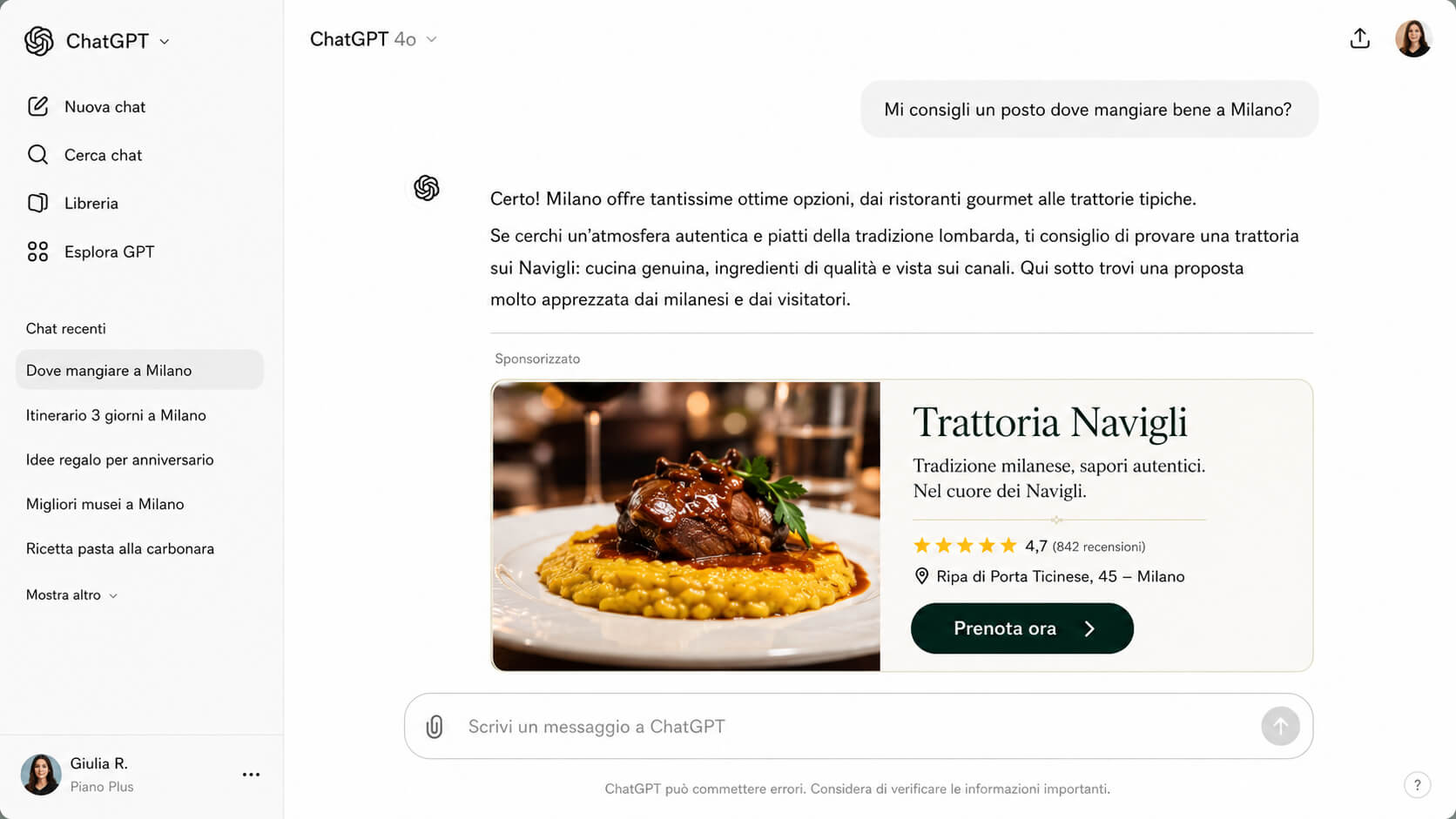
ChatGPT Ads are advertising placements shown within the ChatGPT experience, clearly separated and recognizable from the answer generated by the assistant.
The logic is different from traditional search. On Google, we mainly intercept Search Intent, meaning what the user is already looking for. On ChatGPT, we can intercept Conversational Intent, meaning the need that emerges during a conversation.
B2B example:
- on Google: “B2B Google Ads agency Milan”;
- on ChatGPT: “We invest in Google and Meta, but we can’t understand which campaigns actually bring in customers. How should we set up tracking and attribution?”
In the first case, the user is already looking for a provider. In the second, they are describing a problem. And that is exactly where a company, a software solution, a consulting service or a considered-purchase ecommerce brand can become relevant.
Who can see ads on ChatGPT?
At the moment, ads can be shown to users on Free and Go plans. They are not shown to Plus, Pro, Business, Enterprise and Edu users, nor to accounts identified as belonging to users under 18.
This information is strategic.
If we want to reach a very senior or enterprise B2B target, we need to consider that part of that professional audience may be using ad-free plans. This does not make ChatGPT Ads less interesting, but it does require a more careful evaluation of the media mix.
For some sectors, however, the potential can be very relevant: B2B services, SaaS, consulting, education, universities, B2B ecommerce, automotive, travel, real estate, furniture, electronics and, more broadly, all markets where users compare extensively before making a choice.
What are the advantages of advertising on ChatGPT?
The main advantage is the ability to reach users while they are exploring a topic with a richer level of context than a simple keyword.
In a conversation, the user can explain:
- the problem they are facing;
- the type of solution they are evaluating;
- budget constraints;
- the industry;
- alternatives already considered;
- their level of expertise;
- the goal they want to achieve.
This makes ChatGPT Ads particularly interesting for companies selling products or services that are not purely transactional.
Think of a software house offering ERP integrations, a B2B ecommerce platform with personalized price lists, a business school promoting master’s programs, an HR consulting firm or an agency working on tracking, GA4, automation and dashboards.
In these cases, the user does not always start by searching for a “provider”. They often begin with a broader question: “how can I solve this problem?”. The value of advertising lies in being present at that moment.
Is there a minimum budget to advertise on ChatGPT?
We would not look at budget only in terms of a technical minimum. We would look at the budget required to gather useful data.
As the Key-One team, for a first test we recommend distinguishing between:
- exploratory testing;
- performance testing;
- B2B lead generation testing;
- ecommerce testing;
- brand awareness testing.
A campaign that is too small risks producing too little data and, as a result, too few useful decisions. To properly evaluate a new channel, advertisers need impressions, clicks, different creatives, coherent landing pages and a tracking system capable of measuring both micro and macro-conversions.
For many companies, an initial test should be designed not simply to “spend little”, but to understand whether ChatGPT Ads can generate qualified traffic, commercial enquiries, useful leads, brand interactions or measurable signs of interest.
When and where do ads appear on ChatGPT?
Ads may appear below a ChatGPT response when the system detects a relevant match with the ongoing conversation. They are clearly identified as sponsored content and kept visually separate from the answer generated by the assistant, so that advertising content and conversational content remain transparently distinct.
During the testing phase, ads are not shown in the ChatGPT Atlas browser.
The placement below the response is consistent with the nature of the format: the user can first receive an answer to their question and then see sponsored content connected to the topic or need expressed in the conversation.
How is the ad selected?
The advertising system selects ads by considering their relevance to the conversation and the likelihood that they may be useful or perform well.
Signals considered may include:
- the context of the ongoing conversation;
- the intent expressed by the user;
- the ad landing page;
- the title and copy of the creative;
- contextual indications provided by the advertiser;
- targeting settings;
- selected signals from the user’s broader ChatGPT experience, when ad personalization is enabled.
This means selection does not depend exclusively on a keyword. The system evaluates the overall consistency between what the user is discussing, the advertising message, the offer and the landing page.
For advertisers, it therefore becomes important to keep all campaign elements aligned: context, copy, targeting, destination page and commercial proposition.
How are ads ranked?
When multiple eligible ads are available, the system considers a combination of factors to determine which one to show first.
These mainly include:
- relevance to the conversation;
- advertiser bids;
- predicted results;
- selected user experience signals, when ad personalization is enabled.
Relevance therefore remains a central element, but it is evaluated together with other factors that contribute to predicting the quality and effectiveness of the ad.
How many ads can appear at the same time?
During the testing phase, one or more ads may appear below a ChatGPT response, but only when there is a relevant match with the conversation.
The same ad unit may contain:
- multiple elements from a single advertiser;
- elements from different advertisers;
- a combination of advertising content consistent with the chat context.
In longer conversations, the system may also consider the general context and the user’s overall experience, not only the last question submitted.
For this reason, ad relevance can depend on how the conversation evolves and on how the user’s need is defined over time.
What formats are available?
Ads on ChatGPT are built with elements similar to other paid media environments, but they are placed within a conversational context. In general, a creative may include the advertiser name, logo or favicon, title, descriptive text, image and landing page.
However, the creative should not simply be a copy-and-paste adaptation of Google Ads or Meta Ads.
On ChatGPT, the copy must speak to the problem. It must be clear, specific and useful. It is not enough to say “industry leader” or “innovative solutions”. The ad should explain who the offer is for and what need it solves.
Weak example:
“Discover our digital services.”
More coherent example:
“Want to understand which campaigns generate real customers? We design tracking, GA4, CRM and dashboards to measure the value of B2B leads.”
How do you create a ChatGPT Ads campaign?
A campaign should start from strategy, not from the platform.
The operational process can be summarized as follows:
- define the campaign objective;
- choose the country and geographic target;
- configure budget and bid;
- create ad groups around areas of intent;
- write context hints aligned with the conversations you want to intercept;
- create ads with title, description, image and landing page;
- set up UTMs and conversion measurement;
- launch the campaign;
- monitor performance and traffic quality;
- optimize creatives, landing pages and segments.
For us, the key point is the structure of ad groups. They should not be built only around keywords, but around problems.
Examples:
- low-quality leads;
- difficulty measuring campaigns;
- non-integrated B2B ecommerce;
- need for commercial dashboards;
- university orientation;
- software selection;
- solution comparison.
Which companies can benefit from ChatGPT Ads?
ChatGPT Ads can be interesting for companies selling solutions with a medium-to-long decision-making process or a strong informational component.
Among the most promising sectors, we see:
- B2B and consulting;
- SaaS and management software;
- B2B ecommerce;
- education, master’s programs and universities;
- HR services;
- finance and insurance, in compliance with policies;
- real estate;
- travel;
- automotive;
- furniture;
- electronics;
- premium beauty;
- digital and AI services.
It is less of a priority, at least in the initial phase, for commodity products, highly impulsive purchases or offers where price is the only driver.
How do you measure whether ChatGPT Ads works?
We should not stop at impressions, clicks and CPC.
Useful metrics depend on the objective. For ecommerce, we will look at purchases, add to cart, product views, margin and average order value. For B2B, we will look at forms, demos, quote requests, lead quality, job role, industry, pipeline and sales.
The biggest risk is reading a new campaign through old metrics. An interesting CTR does not automatically mean performance. A low CPC does not mean qualified traffic. Zero conversions may indicate a tracking issue, but also an unsuitable landing page or an intent that is still too high in the funnel.
Advertising on ChatGPT means entering a new paid environment built around conversations, context and decisions.
It does not replace Google Ads, Meta Ads or LinkedIn Ads. However, it can become a channel to test when our goal is to reach users who are exploring a problem and have not yet turned that need into an explicit commercial search.
As the Key-One team, a digital and AI agency based in Milan, we recommend approaching ChatGPT Ads with method: strategy, dedicated creatives, dedicated landing pages, tracking, CRM and dashboards.
Want to understand whether ChatGPT Ads is suitable for your company? We can help you evaluate target, budget, creatives, landing pages and performance measurement within an integrated paid media strategy.